Research Agenda
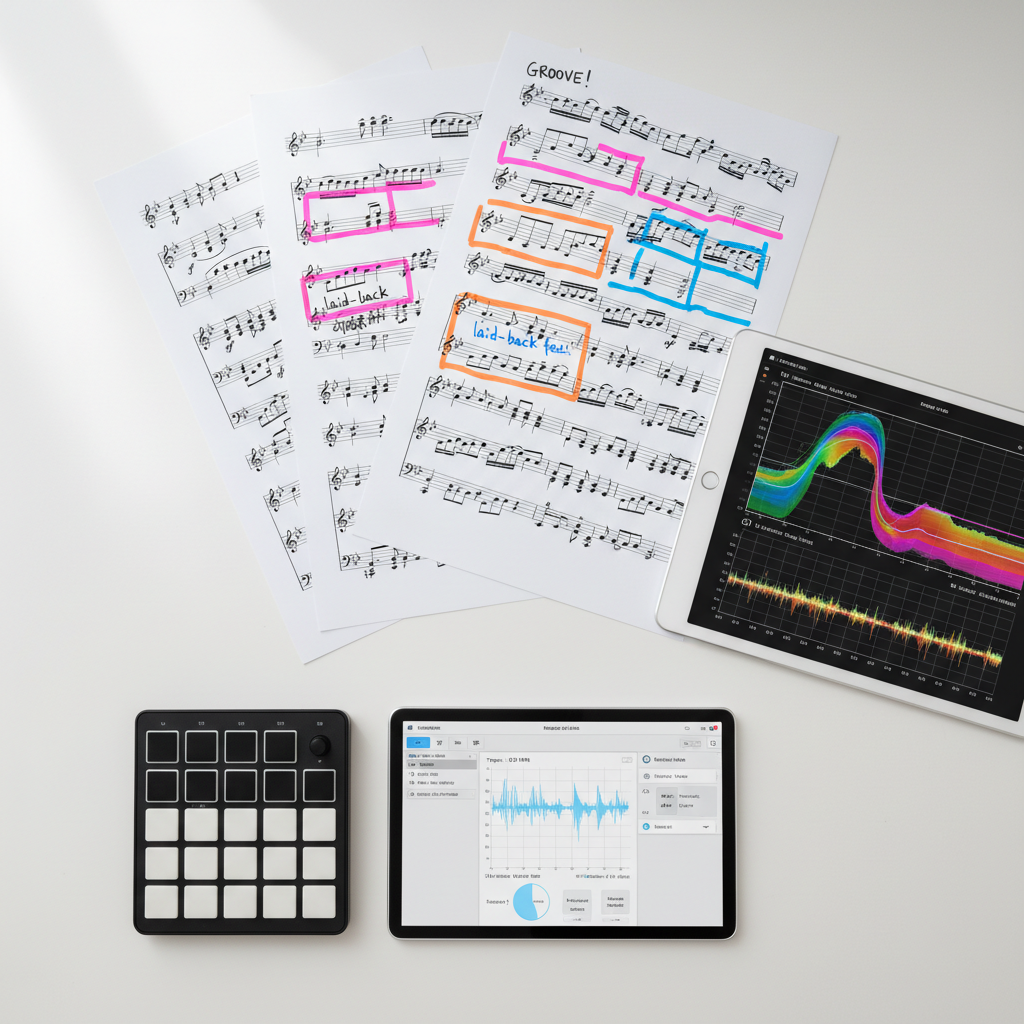
My research sits at the intersection of music theory, empirical musicology, and computational methods. I investigate groove, feel, and microtiming through corpus construction and music information retrieval (MIR). In parallel, I apply natural language processing (NLP) and large language models (LLMs) to inclusive music theory pedagogy, examining representation in teaching materials and integrating AI audio tools into the aural skills classroom.
Publications
Articles
- Hosken, F. (2026). AI stem separation tools in the aural skills classroom. Journal of Music Theory Pedagogy, 39, 39–57. (Special issue on AI and its implications for music theory pedagogy) https://doi.org/10.15763/issn.2994-7073.2026.39.39-58
- Hosken, F., Bechtold, T., Hoesl, F., Kilchenmann, L., & Senn, O. (2021). Drum groove corpora. Empirical Musicology Review, 16(1), 114–123. (Special issue on open science in music research) https://doi.org/10.18061/emr.v16i1.7642
- Hosken, F. (2020). The subjective, human experience of groove: A phenomenological investigation. Psychology of Music, 48(2), 182–198. https://doi.org/10.1177/0305735618792440
Book Reviews & Interviews
- Hosken, F. (2024). Dilla Time: Dan Charnas and Fred Hosken, in conversation. IASPM Journal, 14(2), 211–216. https://doi.org/10.5429/2079-3871(2024)v14i2.13en
Articles in Review
- Hosken, F. (In Review). AI stem separation & MIR: Assessing the validity of analyses that use AI-isolated audio. Empirical Musicology Review.
- Hosken, F. (In Review). Raising heads from the score: Integrating performance analysis in aural skills pedagogy. Engaging Students: Essays in Music Pedagogy.
- Hosken, F. (In Review). Counted but not centered: Demographic diversity and framing in post-2020 music theory textbooks. Journal of Music Theory Pedagogy.

