Psychology of Music, 2018

Falling in Love with Erykah Badu’s Groove
I’ve been trying to explain to various people what it is that I enjoy researching, and thought it was easier to demonstrate it rather than making people grind through 15,000 words of my master’s dissertation [updated and published in Psychology of Music].
Erykah Badu’s ‘Fall In Love (Your Funeral)’ is an amazingly simple track that just feels good. It goes round and round a four-bar loop for six minutes, yet doesn’t get boring:
What mostly grabs my attention is the backing, not Erykah. The track is made up of many layers of synths, bass, and drums. A large amount of this material is sampled from Alicia Keys’s ‘Unbreakable’, which, itself, samples Eddie Kendricks’s ‘Intimate Friends’:
There are a few differences between Erykah and Alicia Key’s tracks – for example there is a hint of shaker in Alicia’s track as well as handclaps on beats two and four – but by far the most noticeable difference between the two is the continuously repeating high synth, chirping away at the top of the texture in Erykah’s track. Something about this chirping grabbed me and made me want to put this track under the musical microscope to understand how the element fits in with the rest of the music and see how this relationship provides the unique feel of ‘Fall In Love’. This constant pattern is in the ‘wrong’ place, yet sounds great!
Wrong Place?
Graphically notated, a bar of ‘Fall In Love’ looks something like this:
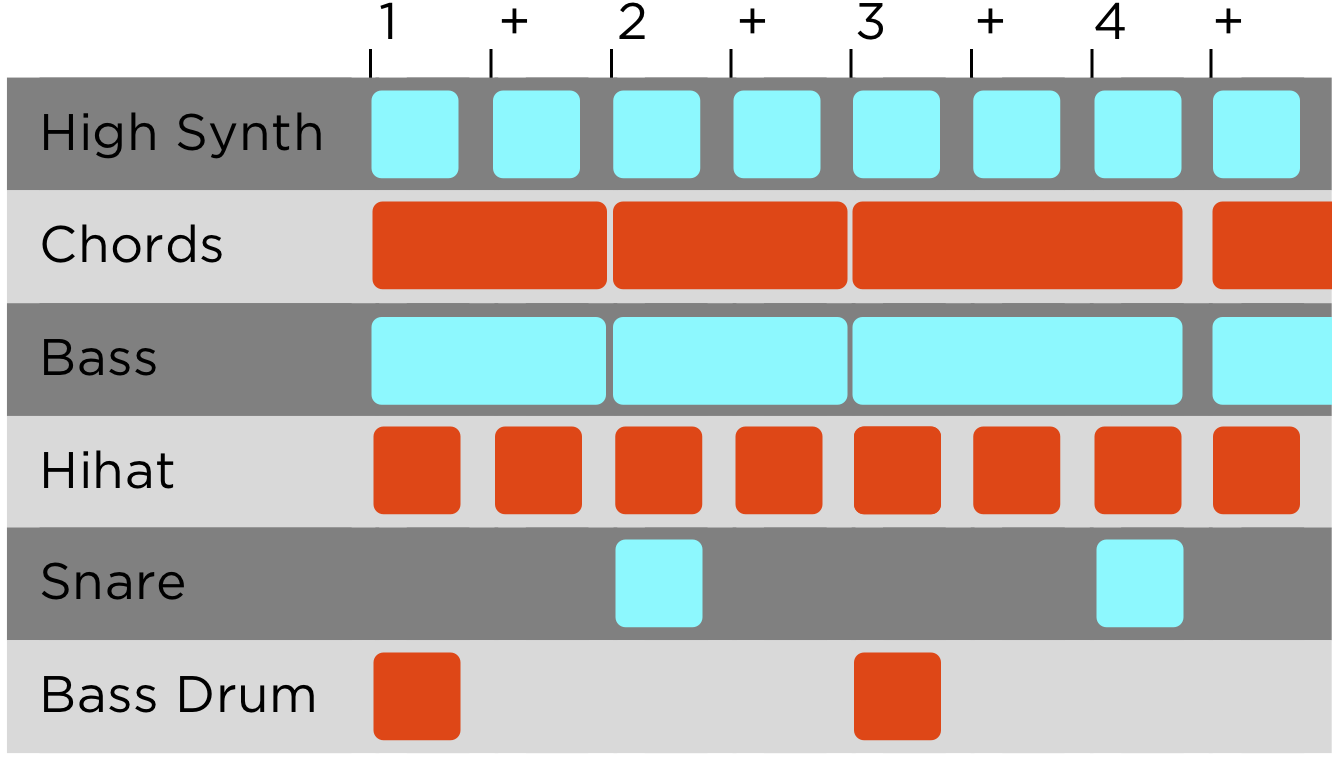
This idealised version is all very neat and even, dividing the bar into eighths. However, in real life, Erykah’s version actually looks like this:
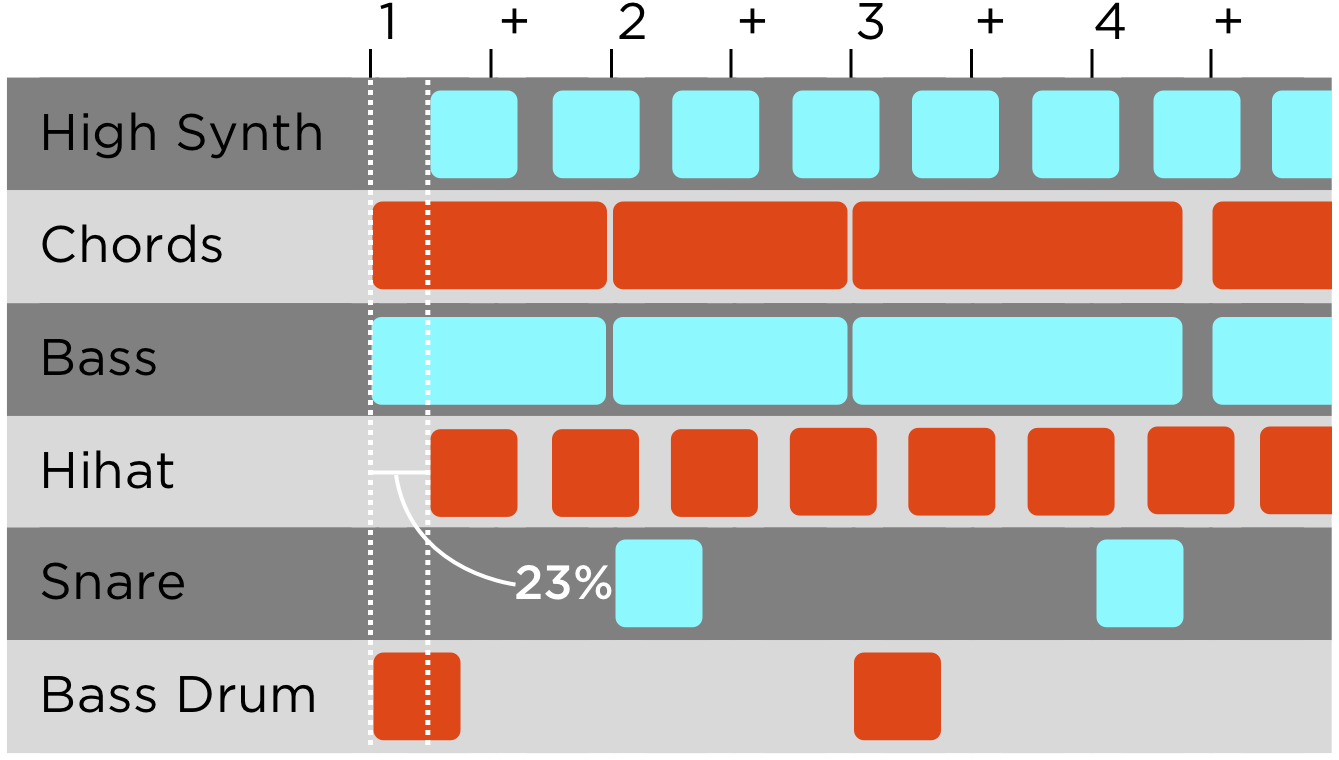
The chirping high synth and hihat consistently come a sizeable 23% of a beat late (taking the bass and snare drum as the fixed location of the beat). This is a very clear example of what researchers call ‘participatory discrepancy’ – the different components of the music do not align; the individual participants (musicians/instruments) have discrepancies between them. This can be heard clearly when you slow the track down to half speed:
Fortunately for Erykah, I have recreated the track and ‘fixed’ it for her…
(And my recreation which includes ~23% participatory discrepancies)
These ‘PD’, which are by no means unique to ‘Fall In Love’, but can be heard to various degrees all over the place in many genres (jazz swing can be described as PD since everyone has a unique swinging ‘voice’ that differs slightly from the other players in the band – a tale for another time), have strange effects on our overall perception of a track. For me, the PD present here create the illusion that the bass and snare drums are swung, despite me programming them into Logic perfectly evenly. It makes the music judder along, slightly unsettled, never quite clear where the secure points are that our ears can grab hold of and use as points of reference. Do we use the high frequencies of the synth and cymbal to provide our grid of reference or do we go with the bass frequencies instead? This internal struggle between components of the music creates some tension that piques my interest and holds my attention.
As a teacher, I’m always asking my students to ‘play that passage evenly’; as a performer in a band, I am mindful that I play with the other musicians and yet, when looking closely at evidence from the vast world of music out there, it becomes unclear why we strive towards these ‘perfect’ goals (perfect rhythm, perfect ensemble playing, perfect pitch etc.). Through the analysis of recordings, we can dissect the individual events that make up a complete performance, to freeze time and inspect the relationships between elements that could normally pass by when listening. Erykah Badu’s ‘Fall In Love’ is a prime example that can be used to open this world up and explore various examples of what researchers call ‘participatory discrepancies’ or ‘microrhythmic phenomena’ and, importantly, the effect on the listener of these.
 Fred Hosken